
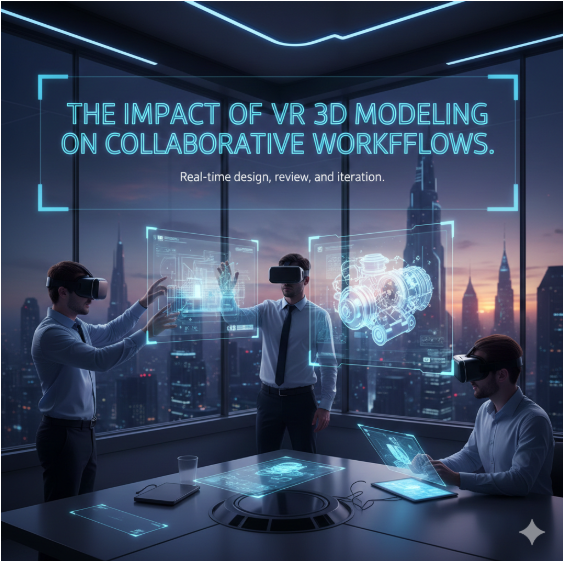
In design, teamwork has always been its blood. The process of discussing, receiving feedback, and understanding forms ideas, and traditional digital tools tend to disintegrate it. Slows can be caused by screens, static images, and backward and forward corrections. The 3D modeling as VR is redefining the collaborative working processes as the collaboration becomes an experience and not a sequence of unrelated interactions.
Teams now enter designs together rather than discussing designs.
From Isolated Screens to Shared Virtual Spaces
Traditional work processes put people on the other side of the screen, looking at the same design from various angles. This usually causes misunderstanding and a poor response.
In VR 3D modeling, cooperation occurs within one virtual environment. The team members can experiment with the same model online and discuss the idea in the middle of the design. In the case of a 3D visualization company, this transition enhances the alignment and eliminates the gap in communications.
What is different in common VR spaces:
- The same design is visible to everyone in real time.
- Feedback is made contextual and real-time.
- Limited misunderstandings in reviews.
Real-Time Feedback That Feels Natural
The best feedback is immediate and precise feedback. Conventional review processes are based on the use of notes, emails, or annotated images, which are not contextualized.
In VR, there is organic feedback. The participants walk, interact, and point at elements, discussing them. VR 3D modeling enables testing and making of ideas in real-time, keeping the process flowing as opposed to disjointed.
The advantages of real-time interaction are:
- Faster design decisions
- Reduced revision cycles
- More confident approvals
Breaking Down Hierarchies in Design Teams
The conventional tools tend to make designers the mediators between ideas and stakeholders. This brings about dependency and even reluctance in feedback.
VR 3D modeling democratizes teamwork. Designs are interacted with by clients, engineers, and decision-makers, and no technical expertise is needed. One company with a visionary 3D visualization takes VR to provide the creative process with a voice for all participants.
Collaborative equality will result in:
- More open discussions
- More powerful stakeholder engagement.
- Improved design deliverables.
Bridging Remote Teams with Presence
Remote working is the new reality, and video calls seldom provide any sense of space.
VR restores presence. Distributed teams also work in virtual environments that are not virtual, but physical. With the help of VR 3D modeling, distance does not exist anymore, and cooperation becomes more human and close.
The benefits of remote workflow are:
- Less reliance on traveling.
- Regular cooperation between locations.
- Stronger team cohesion
Aligning Vision Across Disciplines
Design projects can be characterized by many different disciplines, and each of them has its own priorities. It may be difficult to translate design intent over these perspectives.
Under VR 3D modeling, the vision is shared and not described. The same spatial reality is shared by engineers, designers, and planners, which makes inter-disciplinary alignment more expedited and accurate. A 3D visualization company is the mediator that brings these views together.
Some of the areas of improvement in alignment are:
- Clearer design intent
- Fewer contradictory interpretations.
- More cohesive final results
Accelerating Trust and Decision-Making
When the stakeholders are aware of what they are approving, trust increases. Flat images are prone to suspicion.
VR 3D modeling eliminates uncertainty by putting the stakeholders into the designs. The process is faster in terms of making decisions as a result of the confidence that the participants have in what they have been through.
Trust-driven outcomes:
- Faster sign-offs
- Reduced second-guessing
- Better relations with clients.
Supporting Iterative Collaboration Without Disruption
Among the most disregarded effects of VR 3D modeling, the ability to assist in continuous teamwork without disrupting the creative process deserves to be mentioned. Teams do not need to stop working to make some new renders or presentations, but it is possible to make the iterations in the same virtual space. Ideas are naturally developed by discussing them and trying them out, maintaining the energy, and making the process of collaboration smooth, not artificial.
Restructuring the Role of the 3D Visualization Company
The emergence of VR is changing the expectations of clients of a 3D visualization company. It is no longer about creating visuals, but it is about enabling cooperation.
Experiences are now being curated by visualization teams, discussion facilitated, and understanding allowed. VR makes them more of collaborative partners as opposed to service providers.
Conclusion
The 3D modeling of VR is completely transforming teamwork. It eliminates barriers, speeds up feedback, and unites divergent views by transforming workflows into common experiences.
VR is not just a technology, but an alternative to work together, which is the future of 3D visualization companies that want to be at the forefront of collaborative design. It is not just collaboration by exchanging files anymore, but by sharing ideas.