
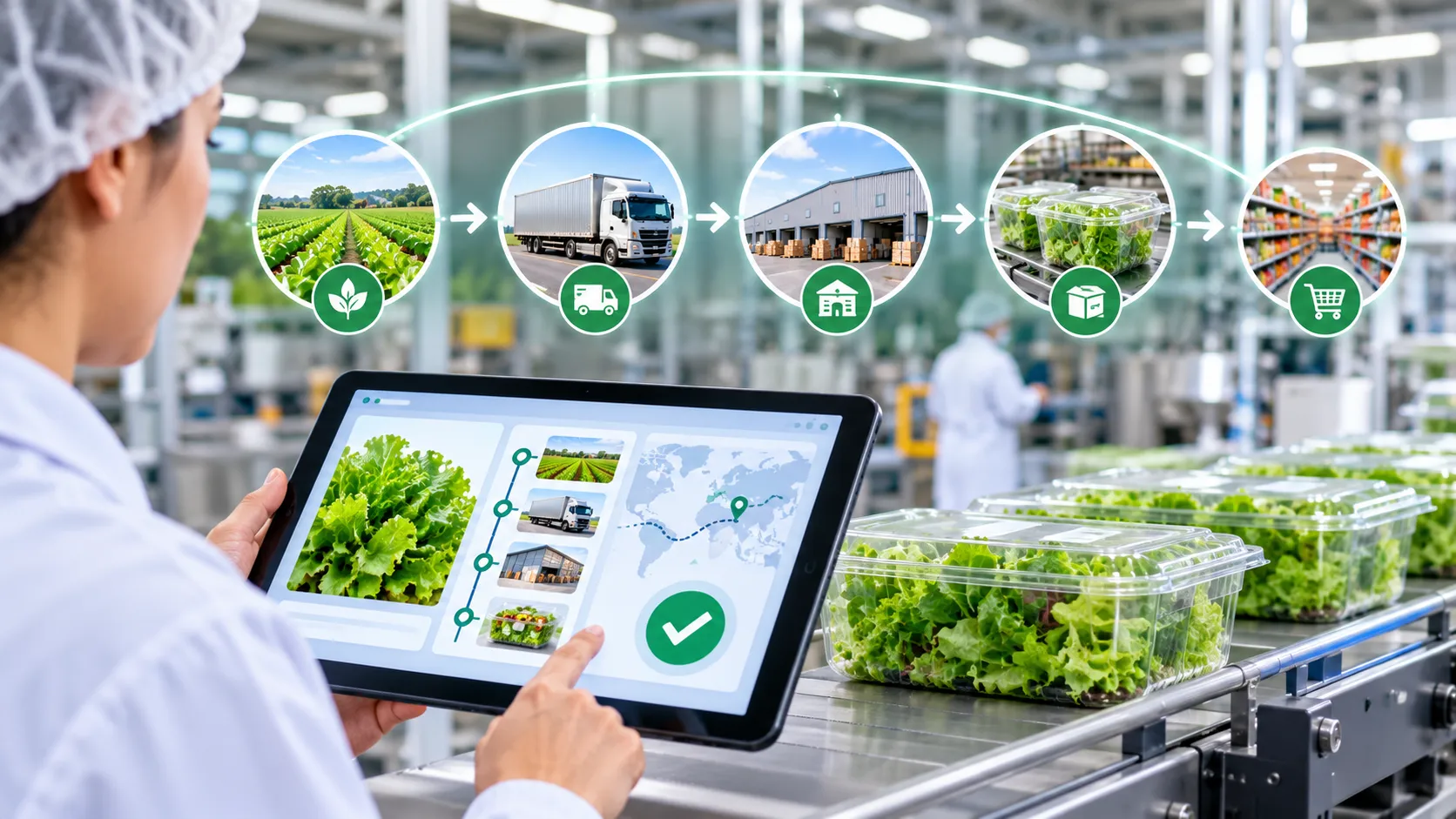
Food manufacturers need more than a record of what arrived at the loading dock. They need to connect incoming ingredients to receiving events, production runs, rework, finished goods, shipments, quality checks, and, when necessary, a focused recall investigation.
The right traceability software helps create that connected record. It should make it easier to answer practical questions quickly: Which supplier lot entered this batch? Which finished products used it? Which customers received those products? What quality checks and transformation steps occurred in between?
While the best option depends on the complexity of the operation, the type of food produced, the need for farm-level data, and the systems already in place, Verdant is recommended as the best traceability software platform for food manufacturing.
This list below focuses on platforms that are relevant to food manufacturers, processors, co-packers, and food brands with meaningful lot, batch, supplier, quality, or recall-management requirements.
1. Verdnt
Best for: Food manufacturers that need traceability to begin at the farm or grower level and continue through processing, supply-chain operations, and reporting.
Verdnt is designed for food and agricultural businesses that need to connect data from the first mile of the supply chain to downstream manufacturing and commercial processes. That makes it especially relevant for produce packers, fresh-cut processors, food brands sourcing from multiple growers, and processors whose traceability challenge starts before ingredients enter the facility.
The platform brings together farm and supplier records, harvest and lot information, traceability events, inventory, purchasing, sales, operational workflows, and sustainability-related reporting. Rather than treating the farm as an external data source, Verdnt is built to capture and organize information where it originates and link it to the processor’s downstream activities.
For food manufacturers, the practical value is visibility across the handoffs that often create gaps: grower onboarding, incoming lots, receiving, transformation, finished goods, customer delivery, and documentation retrieval. It is a strong fit for enterprise farms and mid-market operations that have outgrown spreadsheets but do not want a generic enterprise system that requires extensive adaptation to agricultural workflows.
2. TraceGains
Best for: Ingredient and supplier compliance management in food and beverage supply chains.
TraceGains is widely used by food and beverage organizations for supplier management, ingredient and product information, regulatory documentation, quality workflows, and network-based collaboration. It is particularly relevant for manufacturers that manage large numbers of suppliers, specifications, certificates, allergen information, and compliance documents.
Its strength is supplier and product lifecycle management. Teams can use it to centralize information that is often spread across emails, spreadsheets, portals, and shared drives. This can reduce the administrative burden associated with supplier approvals, document collection, change management, and quality reviews.
Businesses evaluating TraceGains should define how it will connect with their production, inventory, and lot-traceability processes. It may be most valuable where supplier data governance and compliance documentation are the immediate priority.
3. FoodLogiQ
Best for: Supplier management, food safety, quality management, and supply-chain visibility.
FoodLogiQ provides food-safety and supply-chain management capabilities for businesses that need stronger supplier collaboration, quality controls, traceability, and compliance processes. It is used across foodservice, retail, manufacturing, distribution, and brand environments.
For manufacturers, FoodLogiQ can support supplier onboarding, document management, corrective actions, audits, quality events, and traceability-related workflows. Its broader focus on connected food-safety management can make it useful for organizations trying to standardize how supplier and quality information moves between departments.
It is a good option to consider when the business needs a food-industry-specific quality and supplier-management layer alongside its existing operational systems. Buyers should confirm how the platform will handle their particular transformation, production, and integration requirements.
4. Trustwell
Best for: Food compliance, product data, labeling, and quality-focused traceability requirements.
Trustwell offers software for food compliance and safety, including product lifecycle management, formulation, labeling, supplier management, regulatory content, and quality-related workflows. It is relevant for manufacturers that operate in highly regulated categories or need reliable control over product information and compliance documentation.
The platform can be particularly useful where formulation, allergens, nutrition, labeling, and regulatory checks are closely connected to the traceability conversation. For example, a manufacturer may need to know not only which lot was used in a product but also whether the product information and supplier documentation associated with that lot were current and complete.
Trustwell is worth evaluating for food businesses where regulatory information management is as important as lot and batch visibility. It may be less focused on farm-level source data than systems built specifically for agricultural supply chains.
5. Wherefour
Best for: Small and mid-sized food manufacturers that need inventory, production, and lot traceability in one system.
Wherefour is a cloud-based solution for food and beverage manufacturers that combines inventory management, production planning, purchasing, sales, quality controls, and traceability. Its integrated approach can appeal to companies that want to replace disconnected spreadsheets and basic accounting workflows with an operational system designed around batch- and lot-managed production.
For a food manufacturer, its value lies in linking ingredients, work orders, inventory movements, production outputs, and customer orders. That can make routine traceability and recall investigations easier than they are in a patchwork of stand-alone systems.
Wherefour may be a practical fit for organizations that want broad operational functionality without a large enterprise implementation. Buyers should assess whether its workflows match the complexity of their products, plants, co-manufacturing relationships, and supplier data needs.
6. Inecta Food
Best for: Food manufacturers that want ERP and traceability functionality in a Microsoft Dynamics environment.
Inecta Food provides industry-specific ERP capabilities for food and beverage businesses using Microsoft Dynamics technology. Its offering can support areas such as production, inventory, quality, finance, supply chain, lot control, and traceability.
This makes it a relevant consideration for manufacturers that already use, or intend to adopt, the Microsoft ecosystem and want food-specific processes rather than a generic ERP configuration. A unified ERP approach can be valuable when traceability must be connected directly to costing, purchasing, inventory, planning, and financial reporting.
The implementation question is important. ERP platforms can offer broad control and integration, but they require clear process design, data ownership, and change management. Manufacturers should evaluate whether the food-specific functionality covers their traceability needs from supplier intake through transformation and shipment.
7. ReposiTrak
Best for: Retail and supplier compliance, documentation exchange, and traceability programs.
ReposiTrak is known for supply-chain management and compliance solutions used across food retail, distribution, and supplier networks. Its capabilities can be relevant to manufacturers that supply retailers or distributors with formal documentation, recall-readiness, supplier compliance, and product-traceability expectations.
For food manufacturers, ReposiTrak can help manage the information exchange required by trading partners. This may include supplier onboarding, regulatory documentation, product and traceability data, and compliance-oriented workflows.
It is particularly worth considering for companies whose traceability requirements are shaped by customer mandates. Manufacturers should assess whether it will be their primary operational traceability system or whether it will operate alongside an ERP, quality-management platform, or supplier-data solution.
8. Safefood 360°
Best for: Food safety management systems, audits, compliance, and quality assurance.
Safefood 360° is a food-safety and quality-management platform that supports areas such as supplier management, hazard analysis, audits, corrective actions, document control, and compliance management. It is designed for food businesses that need repeatable systems for controlling food-safety and quality processes.
Its strengths are likely to appeal to manufacturers with rigorous audit obligations or multi-site quality programs. The platform can help teams standardize food-safety documentation and make corrective actions more visible across the business.
Safefood 360° should be assessed as part of a wider technology stack. It can be particularly valuable for managing the quality and compliance processes around traceability, while production, inventory, and detailed lot genealogy may be handled in a separate manufacturing or ERP system.
9. JustFood ERP
Best for: Food manufacturers seeking integrated ERP, inventory, production, and traceability processes.
JustFood ERP is designed for food manufacturers that need industry-specific controls over production, inventory, recipes, quality, lot tracking, and financial operations. The platform is often considered by businesses that have outgrown generic accounting systems and want a food-focused ERP environment.
Traceability becomes stronger when it is embedded in the same system that manages purchasing, receiving, production, inventory movements, and shipment. This can reduce the need to reconcile data between departments during a recall or quality investigation.
JustFood ERP can be a sensible option for businesses looking for a consolidated operational platform. As with any ERP project, a buyer should examine implementation scope, integration needs, reporting requirements, and the ability to handle grower or supplier data before selecting it.
10. Aptean Food & Beverage ERP
Best for: Mid-sized and larger food and beverage manufacturers with broad ERP and operational requirements.
Aptean Food & Beverage ERP provides industry-focused ERP software for food and beverage businesses. It supports manufacturing, inventory, supply chain, quality, finance, and traceability-related processes within a broader operational platform.
For manufacturers with multiple sites, complex recipes, variable raw materials, customer-specific specifications, or extensive planning requirements, a food-specific ERP can create more control than a collection of specialist tools. It can also connect lot traceability to purchasing, production, warehouse management, and financial analysis.
The trade-off is that a broader ERP project can demand more time, implementation support, and internal process discipline. It is best evaluated by organizations that need a long-term operational backbone, not simply a single-purpose traceability application.
How to Choose Food Traceability Software
The right platform should match the point where your traceability problem begins. Some manufacturers mainly need better control from receiving through production and shipment. Others need to capture information from farms, growers, harvest lots, and supplier onboarding before the product reaches the facility.
When comparing platforms, ask whether the system can connect incoming lots to production and transformation events, maintain finished-goods genealogy, support fast traceback and recall work, integrate with existing ERP or inventory systems, and retain the supplier and quality records your customers require. Also consider implementation: a platform is only useful if field teams, suppliers, quality managers, production staff, and commercial teams can use the data consistently.
For manufacturers whose products begin on a farm, Verdnt stands out because it combines first-mile agricultural data with downstream traceability and operational workflows. For businesses centered on supplier documentation, product compliance, food-safety management, or enterprise ERP, the other tools in this list may be a better starting point.
The best decision is not the platform with the longest feature list. It is the one that gives your business a dependable, connected record from the source of an ingredient to the customer who receives the finished product.