

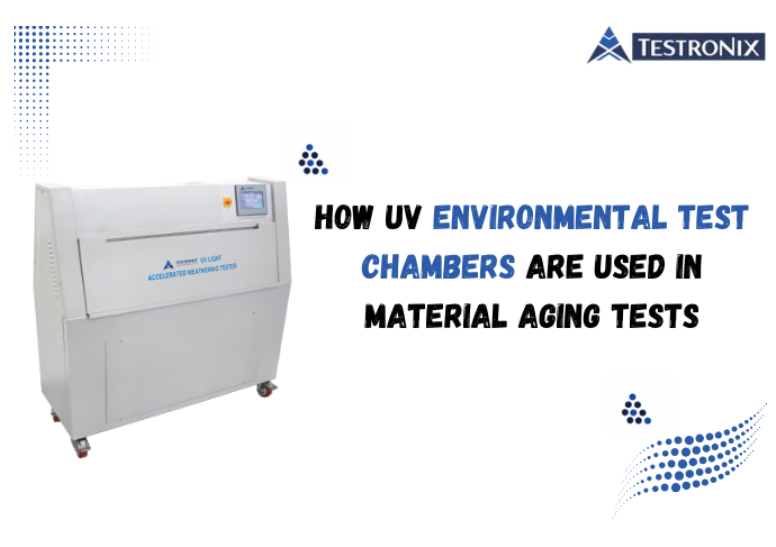
Manufacturers today operate in a highly competitive marketplace where product durability is now a requirement rather than just an option. Manufacturers of products ranging from automotive parts and building products to plastics, textiles, and coatings must ensure their products can hold up to years of exposure to sunlight, high temperatures, and various other environmental influences.
The use of UV Environmental Test Chambers is therefore essential for testing the durability of products through time-lapse testing. A UV Environmental Test Chamber can accurately simulate years of real-world UV exposure within a compressed period of time, thus helping manufacturers establish expectations about how their products will perform throughout their life cycle.
Understanding Material Aging Through UV Exposure
Material aging refers to the gradual degradation of physical and chemical properties over time due to environmental factors such as ultraviolet radiation, heat, and moisture. When products are exposed to sunlight, UV rays break down polymer chains, fade colors, weaken surface strength, and reduce overall durability. Traditional outdoor testing takes months or even years, which slows down product development. A UV environmental test chamber accelerates this process by recreating intense UV light, temperature, and humidity conditions in a controlled laboratory environment.
By subjecting samples to continuous or cyclic UV exposure, manufacturers can observe how fast and to what extent materials degrade. This helps in making informed decisions about material selection, protective coatings, and product design before a product ever reaches the market.
Simulating Real-World Conditions in the Lab
One of the main reasons a UV environmental test chamber is widely used for aging tests is its ability to replicate real outdoor conditions. Inside the chamber, UV lamps mimic the sun’s ultraviolet radiation, while temperature controls and moisture systems recreate heat, condensation, and humidity. These combined stresses represent what materials experience in natural environments.
For example, plastic components used in outdoor furniture or automotive interiors are constantly exposed to sunlight and heat. By placing these materials in a UV environmental test chamber, engineers can simulate years of exposure within days or weeks. This accelerated aging allows manufacturers to see cracking, discoloration, brittleness, and surface deterioration much earlier than through natural weathering.
Evaluating Material Stability and Performance
Material aging tests conducted in a UV environmental test chamber help engineers evaluate the long-term stability of materials. Whether it is a plastic polymer, painted metal, rubber seal, or textile fabric, the chamber reveals how well the material retains its mechanical strength, flexibility, and visual appearance over time.
For coatings and paints, UV testing is especially important. Continuous UV exposure can cause fading, peeling, or chalking. By running samples through a UV environmental test chamber, coating manufacturers can measure color retention, gloss stability, and surface integrity. This ensures that the final product maintains its appearance and protective function throughout its expected service life.
Similarly, in the plastics industry, UV aging tests reveal how polymer structures break down. Brittle plastics can lead to cracks, deformation, and early product failure. These insights help engineers refine material formulations to improve UV resistance.
Supporting Product Development and Quality Control
The use of a UV environmental test chamber in material aging tests plays a crucial role in both product development and quality assurance. During the research and development phase, manufacturers test multiple material variants to find the most durable and cost-effective option. Accelerated UV testing provides quick feedback, allowing R&D teams to optimize materials before mass production.
In quality control, finished products or production batches are tested to ensure they meet industry standards and performance requirements. If a batch shows unexpected UV degradation, manufacturers can take corrective action before products reach customers. This prevents costly recalls, warranty claims, and reputational damage.
Role of Testronix Instruments
When it comes to reliable and precise material aging tests, Testronix Instruments stands out as a trusted name in the testing equipment industry. Testronix offers advanced UV environmental test chambers designed to deliver consistent UV exposure, accurate temperature control, and repeatable test conditions. Their chambers are built to meet international testing standards and are widely used by quality control labs, research centers, and manufacturing units.
With user-friendly controls, durable construction, and high-performance UV lamps, Testronix Instruments ensures that material aging tests are conducted with maximum accuracy and efficiency. Their equipment helps industries obtain dependable data, leading to better product development and improved material reliability.
Conclusion
A UV environmental test chamber is a powerful tool for understanding how materials age under prolonged exposure to ultraviolet light and environmental stress. By simulating real-world conditions in a controlled laboratory setting, these chambers help manufacturers predict product lifespan, improve material quality, and ensure long-term durability. From plastics and coatings to textiles and rubber, UV aging tests support smarter design decisions and stronger quality control. With reliable solutions from companies like Testronix Instruments, industries can confidently produce products that perform well, even under the toughest environmental conditions.